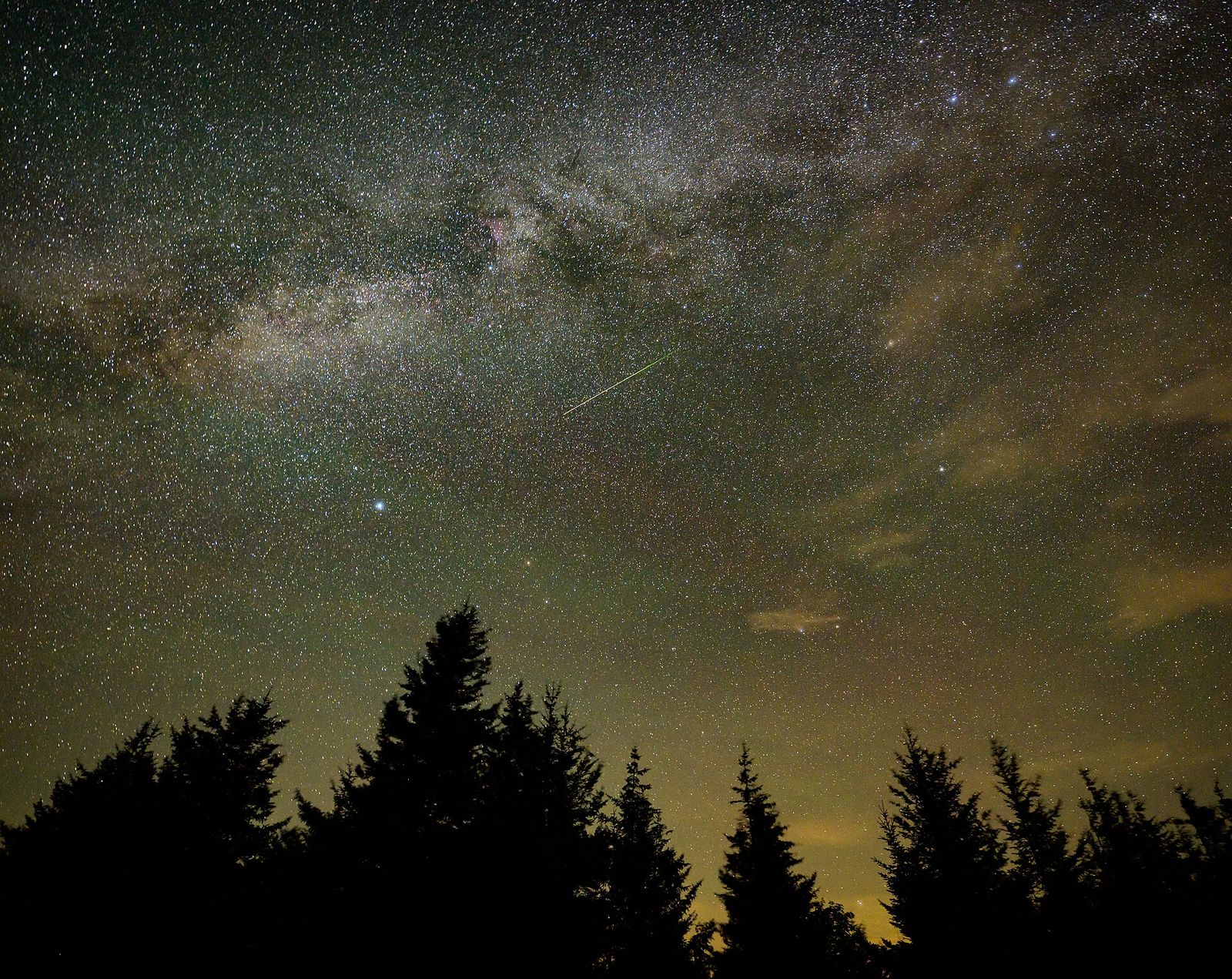
A meteor shower is one of the few astronomical events that needs no equipment at all. You do not need a telescope, an app, or even much knowledge of the constellations. What you do need is the right night, a dark enough place, and the patience to lie back and look at a wide patch of sky for an hour or more. This field note explains which showers are worth planning around, what the published numbers really mean, and how to make the most of a night outside.
What you are actually seeing
A meteor is the streak of light made when a small piece of rock or dust, usually no bigger than a grain of sand, enters Earth's atmosphere at tens of kilometers per second and burns up. On any clear, dark night you will see a few random meteors per hour. These are called sporadic meteors.
A shower happens when Earth passes through a stream of debris left behind by a comet, or in a few cases an asteroid. Because all the particles in that stream travel in nearly parallel paths, their trails appear to spread out from one small area of sky called the radiant. The shower is named after the constellation that holds the radiant, which is why the August shower is called the Perseids and the December shower the Geminids. Earth crosses the same streams at roughly the same dates every year, so the major showers return on a predictable calendar.
The showers worth planning around
The International Meteor Organization (IMO) publishes a detailed calendar each year. These are the showers most observers circle on their calendars, with typical dates of maximum:
- Quadrantids (around 3–4 January): potentially very strong, but the peak is short, around six hours, and the radiant is far north. Poorly seen from the southern hemisphere.
- Lyrids (around 22 April): a medium-strength shower, best from the northern hemisphere, with good rates for about three nights around the peak.
- Eta Aquariids (around 5–6 May): debris from Halley's Comet. A strong shower from the southern tropics, with medium rates further north, mainly in the hour or two before dawn.
- Southern Delta Aquariids (around 30–31 July): another shower that favors the southern hemisphere, with mostly faint meteors.
- Perseids (around 12–13 August): the most popular shower in the northern hemisphere, from comet 109P/Swift-Tuttle. Active from mid-July to late August.
- Orionids (around 21–22 October): also from Halley's Comet. Usually 10–20 meteors per hour at maximum, occasionally much more.
- Leonids (around 17 November): famous for historic meteor storms, but modest in most years.
- Geminids (around 13–14 December): usually the strongest shower of the year, and the one major shower with good activity before midnight. Visible from both hemispheres, though at reduced rates in the south.
Peak dates shift slightly from year to year, so check the current calendar before you plan. The IMO calendar lists the expected time of maximum and how much moonlight to expect on each peak night.
Why you will not see the advertised number
Shower listings often quote a ZHR, or zenithal hourly rate. The Geminids are commonly given a ZHR of around 150, and the IMO lists the 2027 Perseids at 110 or more. That number is a standardized figure: the count an observer would make under a perfectly dark sky with the radiant directly overhead. Real conditions are almost never that good.
In practice, the IMO notes that observers at rural sites usually see around 30 to 50 Perseids per hour at maximum. From a suburb with a bright sky, you may see a fraction of that. The radiant's height matters too. When it sits low in the sky, many meteors are hidden below the horizon. This is why showers with a far-northern radiant, such as the Quadrantids, are weak or invisible from South Africa, Australia or South America, and why the Eta Aquariids are much better from the southern tropics than from Europe.
Treat the ZHR as a way to compare showers, not as a promise.
Moonlight changes everything
The single biggest factor you cannot control is the Moon. A bright Moon washes out the fainter meteors, which are the majority. For example, the IMO calendar shows the 2027 Perseid peak night with the Moon about 79% illuminated, while the 2027 Eta Aquariids peak with the Moon only 2% lit, and the Quadrantids in early 2027 with a thin waning crescent.
When the Moon is bright on a peak night, look for the hours when it is below the horizon. A waxing Moon sets in the evening, leaving the pre-dawn hours dark. A waning Moon rises later, leaving the evening dark. The darkness planner on this site shows when the Moon is up at your location, and our Moon field note explains how its rising time changes through the month.
How to watch
Meteors can appear anywhere in the sky, so you do not need to stare at the radiant. Meteors close to the radiant appear short; those further away have longer trails. A good approach is to face roughly toward the radiant's side of the sky and look about halfway up, taking in as wide an area as you can.
- Give it time. Plan to watch for at least an hour. Meteors often arrive in clusters with quiet gaps in between.
- Lie back. A reclining chair or a sleeping mat lets you look up comfortably without straining your neck.
- Protect your night vision. Allow 20 to 30 minutes for your eyes to adapt, and use only a dim red light. Every glance at a bright phone screen resets the process. Our dark sky field note has more on choosing a dark place.
- Dress for the small hours. Even summer nights become cold when you are lying still. Bring more layers than you expect to need.
- Skip the binoculars. Their narrow field of view makes it less likely you will catch a meteor. Your eyes are the right tool for this.
Most showers are richer after midnight, because that is when your side of Earth faces forward along its orbit, sweeping up more particles. The Geminids are the major exception, with good rates from late evening.
Fireballs and what to do if you see one
Occasionally a meteor is brighter than any planet. These are called fireballs, and some showers, including the Quadrantids and the autumn Taurids, are known for producing them. If you see one, note the time, the direction it traveled, and roughly where it started and ended against the stars. Organizations such as the IMO and the American Meteor Society collect fireball reports from the public to help work out the object's path.
A simple plan for your next shower
Check the calendar for the next major shower and note the Moon's phase. Choose a safe, legal place with an open view of the sky and as little artificial light as possible. Check the weather forecast. Then go out on the peak night, or the night either side if the weather is better, and give the sky at least an hour of patient attention. If you are also curious about what else is moving overhead, read how to tell a planet from a star and how to time a space station pass.
Sources and further reading:
- International Meteor Organization: Meteor Shower Calendar 2026/2027
- International Meteor Organization: 2027 Meteor Shower Calendar (PDF)
- NASA: Meteors and meteorites
Original field note · Published 11 November 2026.