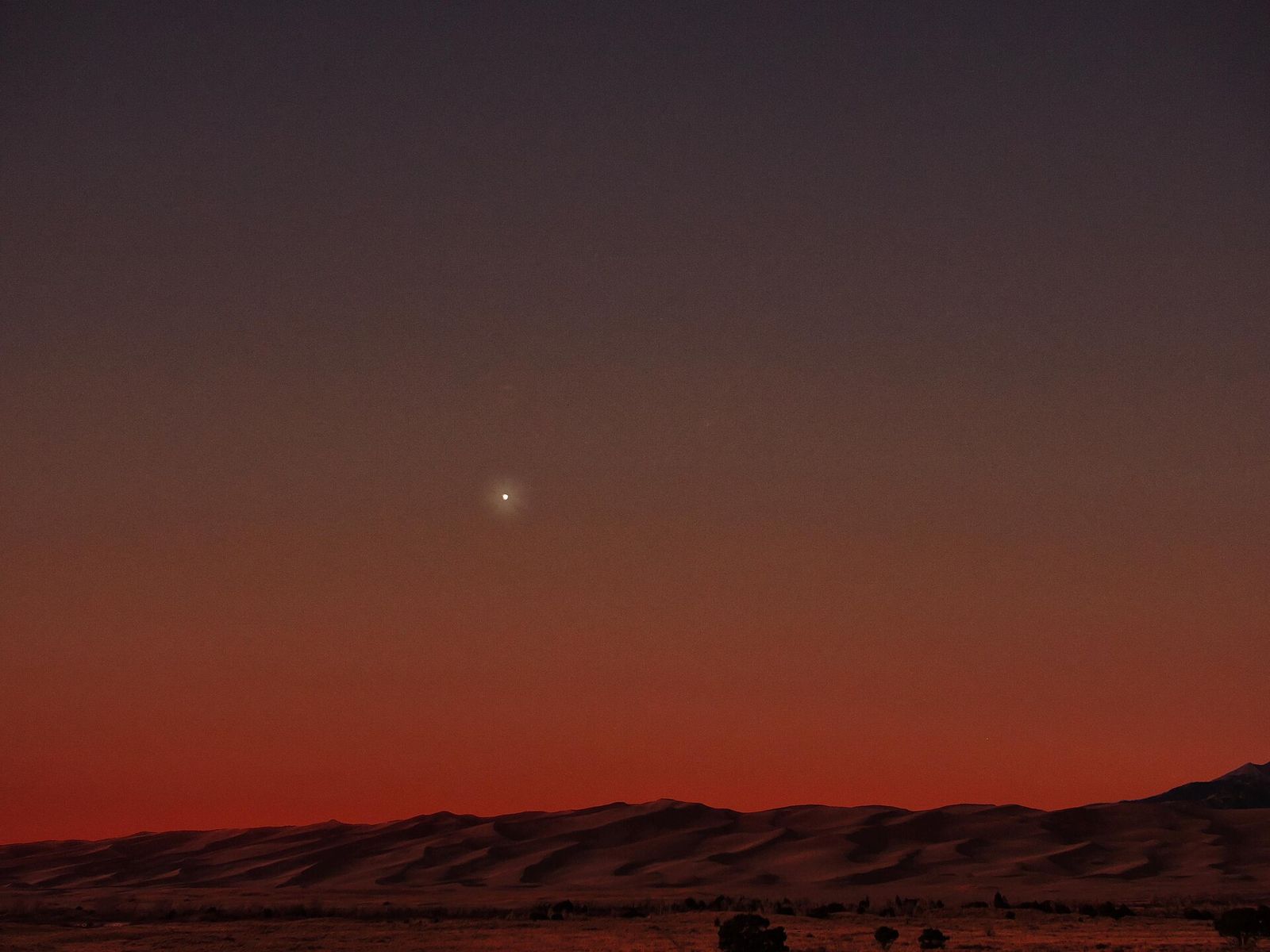
Start with where it is.
The planets do not wander all over the sky. Because the planets orbit the Sun in nearly the same plane as Earth, they always appear close to the ecliptic: the line the Sun follows across the sky during the year. The Moon stays near that line too. So if a bright point sits roughly along the path where the Sun set and the Moon rises, a planet is a strong possibility.
A very bright “star” low in the west just after sunset, or low in the east before dawn, is very often Venus. Venus orbits closer to the Sun than we do, so from Earth it never appears far from the Sun in the sky. You will never see it high overhead at midnight. After the Moon, it is the brightest natural object in the night sky.
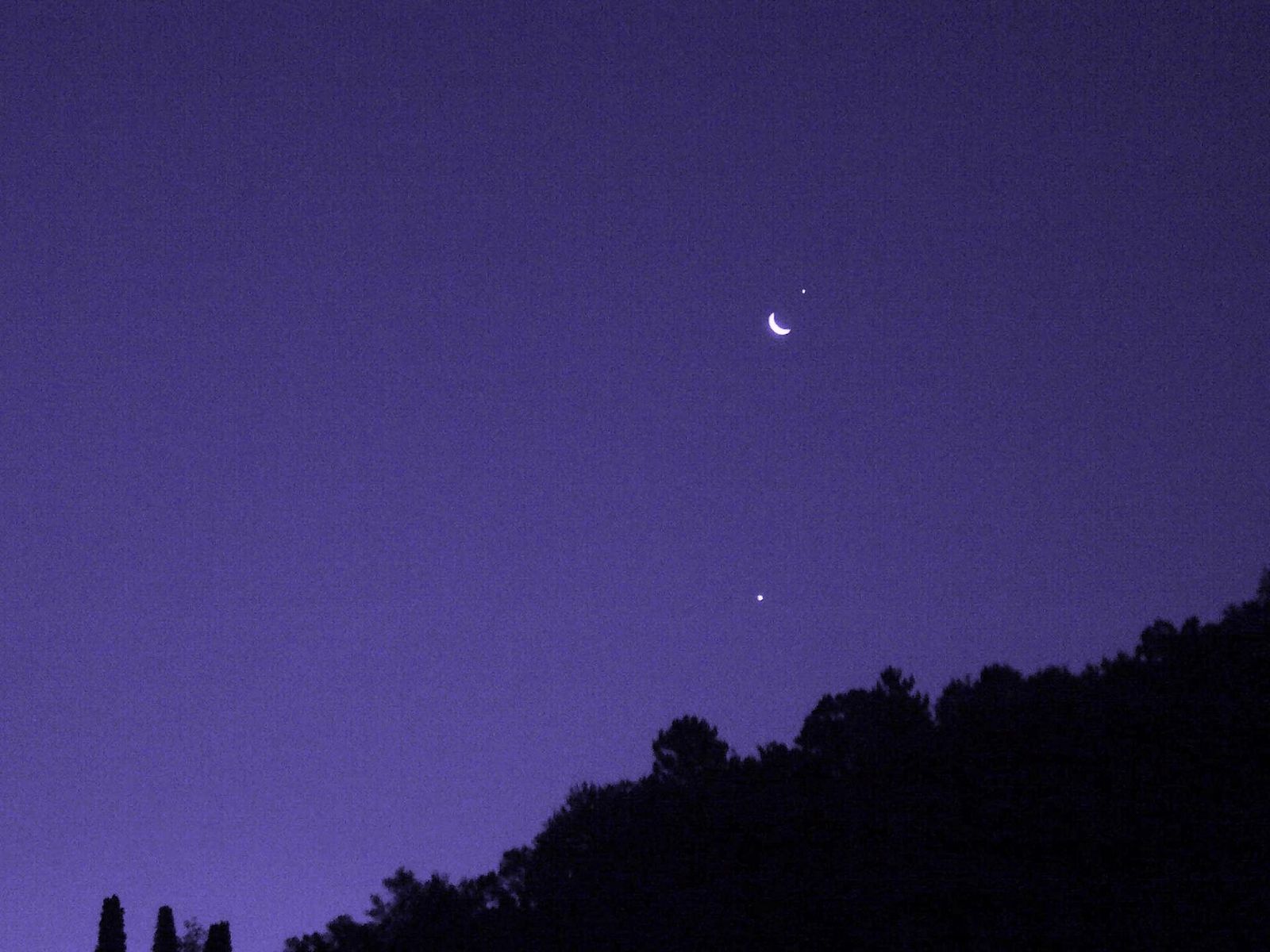

Watch whether it twinkles.
Stars are so far away that they are effectively points of light. Moving pockets of air bend that thin thread of light back and forth, which makes stars twinkle. Planets are much closer, so they show a tiny disc rather than a point. The flicker from different parts of the disc tends to average out, and planets usually shine more steadily.
This is a tendency, not a law. Close to the horizon you look through much more air, and even a planet can shimmer and flash colors there. The test works best for objects at least a third of the way up the sky.
Use color and brightness as clues.
- Venus: brilliant white, always near the Sun’s side of the sky, in the evening or morning only.
- Jupiter: very bright, creamy white, and it can be visible for much of the night when it is well placed.
- Mars: noticeably orange-red. Its brightness changes a great deal over its roughly two-year cycle, from very prominent to fairly ordinary.
- Saturn: pale yellow and steady, bright but less dazzling than Jupiter.
Which planets are up changes from month to month. NASA publishes a monthly What’s Up guide that tells you which ones to look for and when.
If it is moving, it is not a planet.
Planets and stars appear fixed over a few minutes. If a point of light glides steadily across the sky without blinking, it is very likely a satellite catching sunlight, and it may fade out mid-sky as it passes into Earth’s shadow. If it has blinking or colored lights, it is an aircraft. The space station field note explains how to time a satellite pass.
Check again tomorrow night.
The word planet comes from the Greek for “wanderer”. Over several nights or weeks, a planet slowly shifts its position against the background stars, while the stars keep their patterns. If you sketch or photograph the bright point next to two or three nearby stars and compare a week later, a planet will have moved.
Then reach for binoculars.
Steady binoculars are often enough to confirm Jupiter: look for up to four tiny points of light in a nearly straight line beside it. Those are its four largest moons, first recorded by Galileo in 1610, and their arrangement changes from night to night. A small telescope will show Saturn’s rings. A star, however bright, stays a point.
Planning helps. Open the darkness planner to see when the sky is properly dark and when the Moon is up at your location, then read When dark is really dark for choosing a place to stand.
Further reading and factual references:
Original field note · Published 11 November 2026.