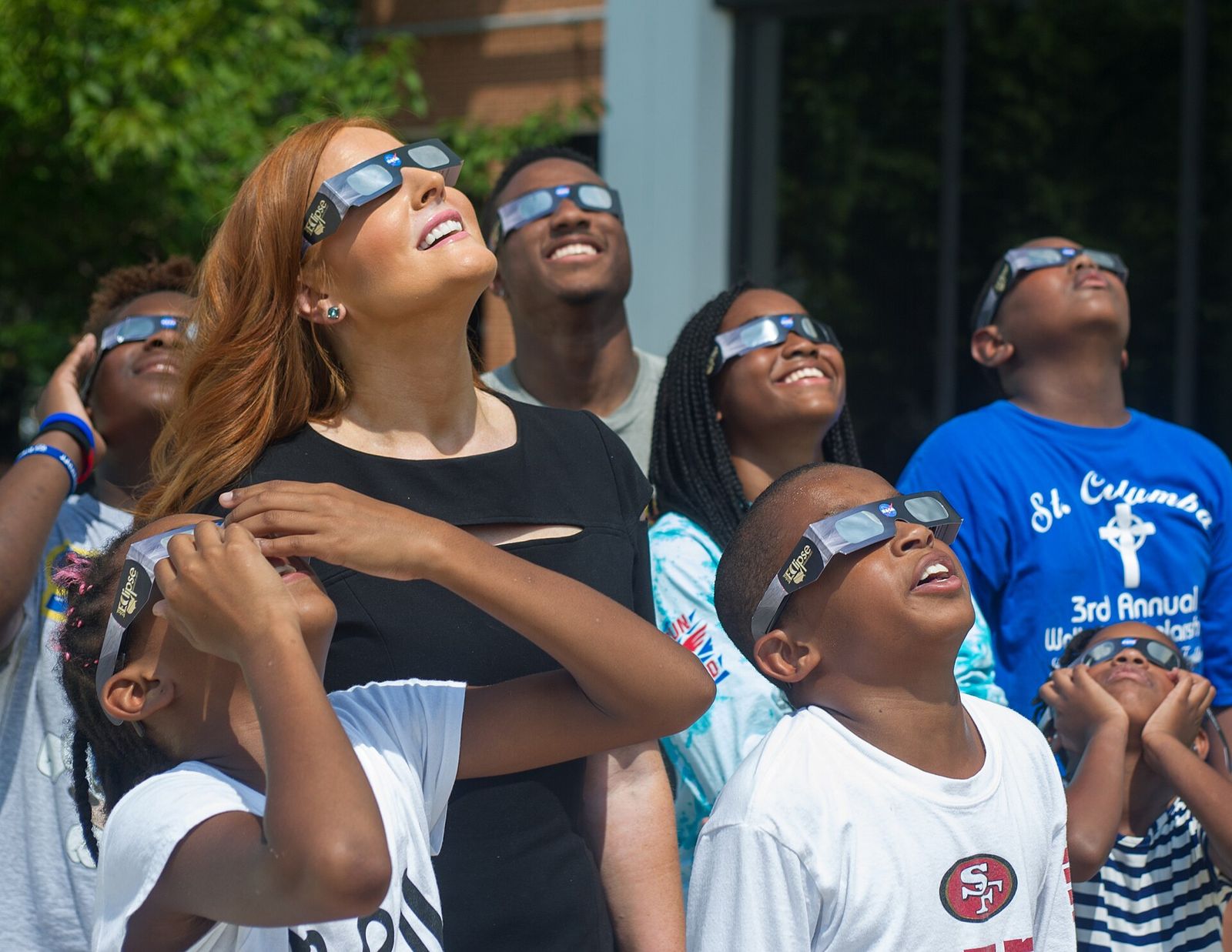
A solar eclipse is one of the most memorable things you can see in the sky. It is also the one astronomical event where a moment of carelessness can cause lasting harm. Looking at the bright Sun, even when most of it is covered by the Moon, can damage the retina, and the damage is often painless at the time.
The good news is that safe viewing is easy and cheap. This field note explains what to use, what to avoid, and the one short period when you can look without protection.
Three kinds of solar eclipse
A solar eclipse happens when the Moon passes between Earth and the Sun. How it looks depends on where you are and how far away the Moon is at the time.
- Partial eclipse: the Moon covers only part of the Sun. Most people who see an eclipse see this kind, because the partial zone is much wider than the central path.
- Annular eclipse: the Moon passes centrally across the Sun but is too far from Earth to cover it completely, leaving a bright ring.
- Total eclipse: within a narrow path, the Moon completely covers the Sun's bright surface for a few minutes. The sky darkens, bright planets and stars appear, and the Sun's faint outer atmosphere, the corona, becomes visible.
NASA's safety guidance is clear: during partial and annular eclipses, it is never safe to look directly at the Sun without proper eye protection. Even a thin sliver of exposed Sun is intensely bright.
What makes eclipse glasses safe
Safe solar viewers are not sunglasses. NASA describes them as thousands of times darker than ordinary sunglasses, and the American Astronomical Society (AAS) notes that even very dark sunglasses transmit thousands of times too much sunlight.
Eclipse glasses and handheld solar viewers should comply with the international standard ISO 12312-2. The standard sets the maximum amount of visible, infrared and ultraviolet light the filter can let through, along with requirements for uniformity, quality and labeling. The AAS explains that the standard also sets a minimum amount of visible light, so the image is bright enough to be useful.
Before each use:
- Inspect the filters. NASA advises discarding any viewer that is torn, scratched, punctured or otherwise damaged.
- Buy from a reputable source. Before major eclipses, counterfeit and uncertified viewers have been sold. The AAS has maintained guidance on identifying reputable suppliers.
- Supervise children. Make sure the glasses stay on while they look at the Sun.
- Keep wearing your glasses over prescription glasses. Eclipse glasses fit over normal spectacles.
Never combine eclipse glasses with optics
This is the mistake that causes the most serious injuries. Binoculars, telescopes and camera lenses concentrate sunlight. NASA warns that looking at the Sun through any of these while wearing eclipse glasses is dangerous, because the concentrated rays can burn through the filter and cause serious eye injury.
To use optics on the Sun, you need a special solar filter attached securely over the front of the instrument, never at the eyepiece end. NASA recommends seeking expert advice from an astronomer before using a solar filter with any optical device. If you are not sure, leave the binoculars in the bag. Our binoculars field note covers night-time use only.
Indirect viewing: the pinhole method
You do not need any special equipment to watch an eclipse indirectly. NASA describes a simple pinhole projector:
- Stand with the Sun behind you.
- Hold a piece of card with a small, clean hole punched in it.
- Let the sunlight pass through the hole onto a second card or the ground.
- Watch the projected image of the Sun change shape as the Moon moves across it.
During the partial phases, the image becomes a small crescent. The holes in a kitchen colander, or the gaps between leaves on a tree, project dozens of little crescents onto the ground. Never look at the Sun through the pinhole itself.
Totality: the one time you can look
During a total eclipse, and only within the path of totality, there is a short window when the Moon completely covers the Sun's bright face. NASA's guidance is that you may then look directly with no protection. You will know it is safe when you can no longer see any part of the Sun through your eclipse glasses.
As soon as even a little of the bright Sun reappears at the end of totality, put your glasses back on immediately or switch to a pinhole projector. If you are outside the path of totality, there is no safe moment to remove your glasses.
The next big one: 2 August 2027
On 2 August 2027, a total solar eclipse will cross parts of Spain, Gibraltar, Morocco, Algeria, Tunisia, Libya, Egypt, Saudi Arabia, Yemen and Somalia, according to the National Solar Observatory. A partial eclipse will be visible across a much wider area of Europe, Africa, the Middle East and south Asia.
This eclipse is unusually long. EclipseWise gives a maximum duration of about 6 minutes 23 seconds, near Luxor in Egypt. Partial phases before and after totality will last well over an hour at most locations, so plan to have certified glasses for everyone in your group, and sun protection for your skin, as NASA reminds observers that they may be in direct sunlight for hours.
Plan ahead
- Get viewers early. Supplies run short and prices rise in the weeks before a major eclipse.
- Check the local circumstances. Use an eclipse map to find the start, maximum and end times for your location, and how much of the Sun will be covered.
- Watch the weather. Have a backup location in mind if clouds are forecast.
- Enjoy the surroundings. During a deep partial or total eclipse, light changes in strange ways, temperatures drop and animals may behave differently.
After the eclipse, the night sky offers plenty more to see. Read which meteor showers are worth staying up for, or use the darkness planner for your next night out.
Sources and further reading:
- NASA: Eclipse safety
- American Astronomical Society: Ensuring the safety of eclipse glasses and handheld solar viewers
- National Solar Observatory: August 2, 2027 solar eclipse map
- EclipseWise: Total solar eclipse of 2027 Aug 02
Original field note · Published 11 November 2026.